Showing posts with label Rebels & Patriots rules. Show all posts

Friday, January 10, 2020

Back to the Vendee with Rebels & Patriots


Last Thursday we got around to playing a rematch of our skirmish in the Vendee. The previous game report can be found here. The rules are Rebels and Patriots. After that game I decided to get rid of the wheat field and all green unit ratings (except the free unit) to speed the game up. In truth, there are quite a few units on the table for R&P, which usually has 24 points a side or less.

I had wished to play the Whites last game and did so here, planning on showing how to play the angry peasants armed with a mix of muskets and pole-arms. But then my last attempt to demonstrate proper cavalry tactics during our Seven Years War game didn’t quite work out.

The defending Whites, Catholic royalist peasants, are led by their noble, Sangre Bleu. His character trait is “familiar face” which allows a free line infantry unit of locals who join the cause and have no effect on force morale.

6 Natives, Vendee Rebels
12 figures each
@ 4 points each
1 Skirmisher
6
@ 2
1 Line Infantry, green, timid, poor shooters
12
Free
Total
90
26 points

The attacking Blue revolutionaries are led by the townsman Parvenu, said by the Whites to be a Huguenot. His trait is “blessed”, strange for the chap leading the atheist side. Perhaps he is a secret believer. It makes him harder to kill. Parvenu gained 6 honour points in the last game. The Blues are tasked with taking the hamlet of Sacre Coeur and teaching the locals a lesson.

7 Line Infantry
12 figures each
@ 4 points each
1 Skirmisher
6
@ 2
1 Medium Artillery
4
@ 6
Total
94
36 points

The attackers deployed half of their units within 6” of their table edge, followed by half of the defenders at least 16” away from the attacker’s edge. Then the remaining attackers deployed followed by the remaining defenders with the same restrictions.   

Victory points: 3 points for control of the hamlet of Sacre Coeur at the end of the game, 2 points for losing less than 1/3 of your force’s points, 1 point for causing at least 1/3 point loss to the enemy.
A short recap of the fight is that we spent the early part of the game trying fancy footwork, skirmishing up to the hedgerows and then falling back. We got shot to ribbons for our efforts. Late in the game we discovered that charging the enemy was our strong suit, but found out too late to turn the tide. Pictures follow. (Line infantry units with dried cherries have not yet fired or been in melee.)


Rolling boxcars during an activation gets you good things; rolling snake eyes punishes you. Andrew arrived after he got off work and got command of a reinforcement unit that arrived from a boxcars roll. He promptly attacked and destroyed Blue skirmishers who had infiltrated past the hamlet; they failed to evade. We broke for dinner, a fine chili verde prepared by my wife. After dinner Ken said he would be going soon, so Andrew switched sides. He’s been away for a while, with his kids taking turns with colds and such. He made up for lost time with aggressive play and some hot dice.

Jay and I had been pressed back towards Sacre Coeur, taking losses from Blue firepower as we went. My theory about using skirmish mobility to offset Blue musketry was failing badly. With our backs against the wall, we launched charges and found the native troop type quite formidable with cold steel. One of our units gained a discipline advantage termed “fighting cocks” via a boxcars roll and got a vivandiere figure as a marker. One of Andrew’s also got one. I looked for the plastic rooster my wife gave me when we were playing games of Marengo but could not find it. Andrew’s unit was marked with a plastic mouse my wife had given me. Andrew roared about the ferocity of said mouse, causing hurricane gusts of laughter. Bill now rolled an activation snake eyes and fired on one of his own units, causing a couple hits and more laughter. We laughed too soon as a similar result saw our unit in the hamlet fire on friends. 


Andrew’s fierce mouse unit was driven back twice in a turn by angry rebels who then failed a morale test with truly lousy dice and routed off the table.
In the ensuing turn the Blues opened fire on the rebel units that had cut their way into Blue lines. Some routed, causing more morale tests and a general collapse. We escaped ignominy for our leader on a snake eyes roll because he had already been carried from the field wounded. We threw in the towel.

The game took about three and a half hours during which we played 13 turns. Jay suggested that a time limit of some sort be put on the scenario. It has none at this time. Since the rebels have lost both games, he may have a point.

Royalist losses were 3 native units and 1 skirmisher lost for 14 points of 29, over 1/3 points lost, the CO wounded, 34 figures shot and another 32 ran away (including 9 “free” ones). The Blues lost a line unit and a skirmisher unit for 6 points of 36, 24 figures killed or wounded and 9 ran away. A couple of the last were likely taken prisoner.

The Blues took the town, lost less than 1/3 points and caused more than that to the enemy for a total of 6 honour points, giving CO Parvenu a campaign score of 12. 8 more will see him promoted and gain a new trait. Poor Sangre Bleu recovered from his wound but gained no points. His score remains zero. Perhaps next time he can do better. A new scenario might help. Perhaps a raid on Blue supplies…

I intended to teach a lesson in how to use the Vendee rebels and instead was taught one. They need to close with the enemy as quickly as possible with a minimum of musket fire. I don’t know enough about the actual fighting to know if this represents the way they fought, but certainly seems like the way Highlanders of the ’45 rising fought.

Rules details for game geeks: a native unit in good order that charges a line infantry unit in the open will roll 12 dice, needing 4+ for hits, 2 hits per figure loss caused. The odds call for 6 hits, 3 figures removed. The line unit rolls 12 dice needing 6 for hits. Odds call for 2 hits, one figure lost. The line falls back and both check morale. If the natives pass, they can follow up and do it again. That’s pretty strong stuff.

If the natives charge a line behind an obstacle (like a hedgerow) they roll 12 dice as before but need 3 hits to remove a figure. They should cause 6 hits again, removing 2 figures. The line as before should cause 2 hits, removing 1 figure and thus lose the fight. Again, if the Natives pass their morale check they can follow up and hit the line in the open, unless the line manages to fall back behind another obstacle.

Getting into position for a charge without being hurt by superior enemy firepower remains a problem. I knew natives had an advantage in melee but didn’t realize how strong until we charged in desperation near the end of the game.

Friday, December 20, 2019

Seven Years War redux, Rebels & Patriots


This a reprise of the game we last played in November (report here) using the Rebels & Patriots rules with larger units of Seven Years War 15mm troops. We used a base of 2-3 figures in place of single figures. We had a larger attendance than has been usual lately.

The game is based on the Lament Ridge scenario in the rules with a crossroads replacing the ridge. Holding the crossroads at game end is worth 3 points, causing 1/3 point loss to the enemy is worth 1, and avoiding 1/3 point loss for your own side is worth 2 points. The order of battle is listed below.

Austrians, led by General Esterhazy, a ballroom darling (can move a unit 3” extra once per game)
3 line infantry battalions (1 is Hungarian, no special rules)   
@ 4 points each
1 half battalion Grenzer skirmishers              
@ 2 points
1 squadron (small unit) shock cavalry dragoons
@ 5 points
1 squadron (small unit) shock cavalry cuirassiers
@ 5 points
1 section medium artillery
@ 6 points
Total 30 points, no special rules in this scenario for cuirassiers

Prussians, led by General Zeitgeist, wheezy (avoids going into the woods, no big deal with this force)
2 line infantry battalions
@ 4 points each
1 line infantry battalion, good shooters
@ 6 points
2 squadrons (small units) shock cavalry 
@ 5 points each
1 section medium artillery
@ 6 points
 Total 30 points

Zeitgeist earned 6 points in the last game. If he earns 14 more he may be knighted and allowed to use the von prefix. And a roll on the traits table to see if he can pick up something better than wheezy.

Bill played the Prussian Zeigeist aided by Ken. I played the Austrian Esterhazy seconded by the brothers Rick (left flank) and David (right flank). Unfortunately Jay and Andrew could not attend due to illness in their families. We all hope this is soon alleviated.

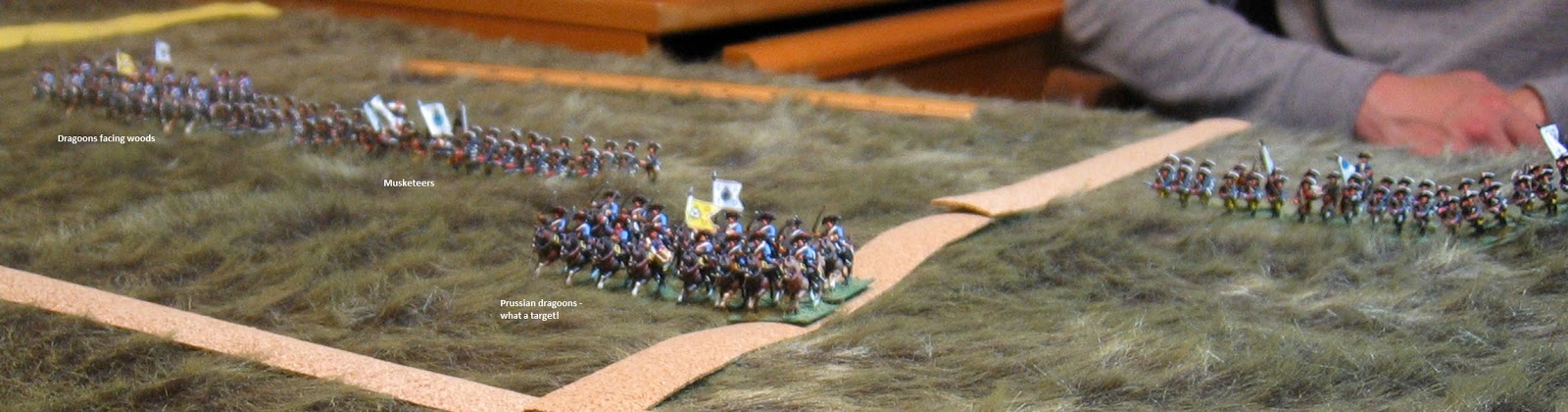
My plan was to engage with infantry and artillery, holding our left flank back since it faced the best Prussian unit, the “good shooters”. The cavalry would be in reserve and would ride out and fall on any Prussian unit that became disordered or badly shot up. I would show the guys how to lead cavalry. We’ll see how that turned out. As in the last game, Esterhazy’s trait was forgotten. I could have used the extra 3” bonus move at least once. Perhaps I’ll put my vivandiere next to him as a reminder. Now, on to the game.


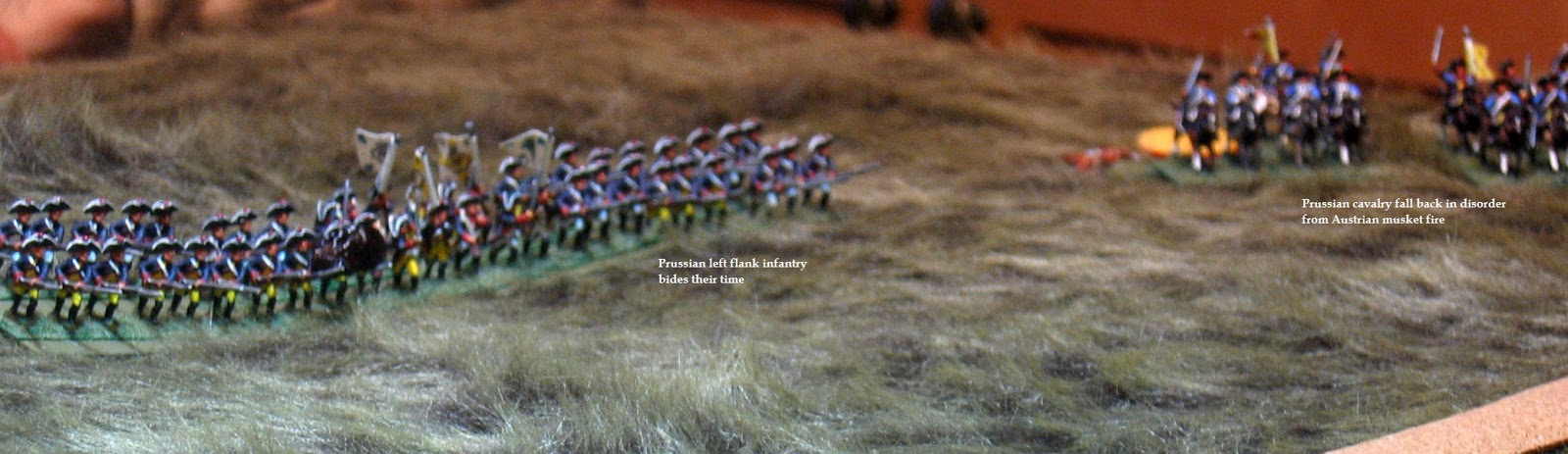
A disorder marker on left flank Prussian cavalry got my attention and I planned a strike by both squadrons of cavalry.


Then the lead squadron decided to feed their horses. Being in close order, my squadron could not pass through and tried to move around them, slowing the whole procedure.


Then the lead squadron took off and Esterhazy decided it was time to make a long speech to the troopers.


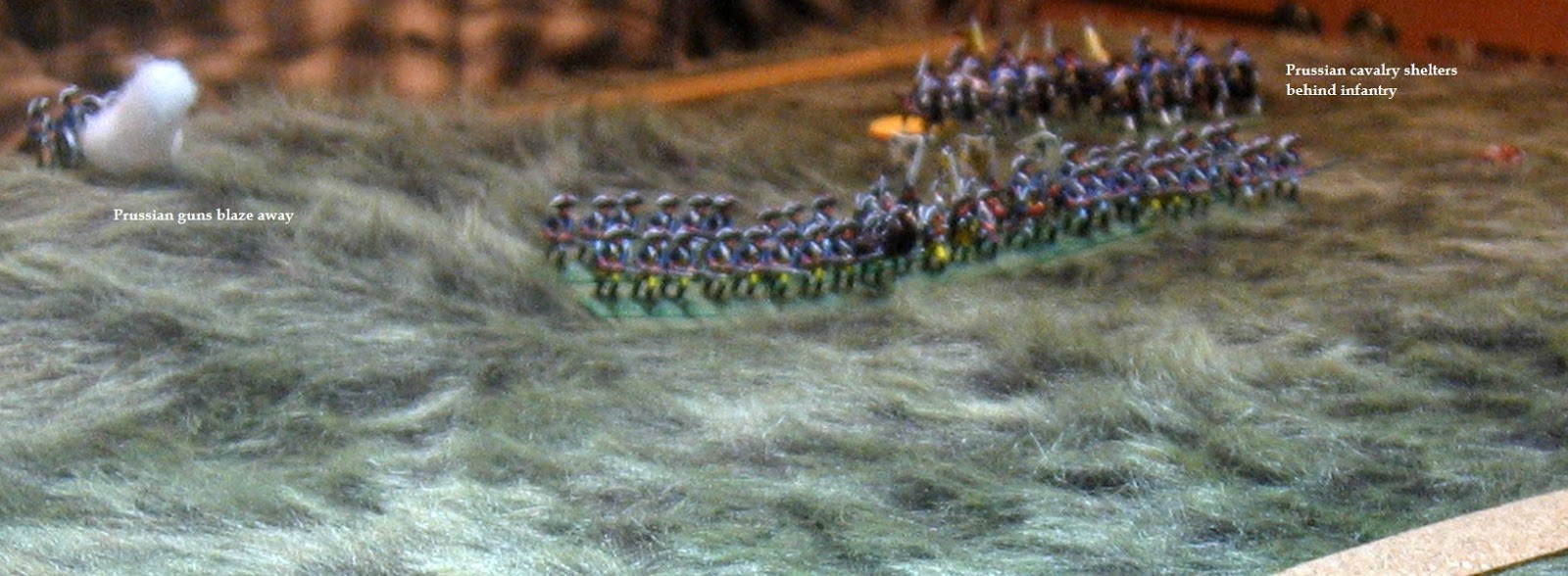
The shot up Prussian right flank cavalry showed their faces after the Fusiliers routed the Austrian artillery with musket fire from the woods. The Hungarians were chased off the hill after that. I had not been taking care to note when the Fusiliers were available targets.


We began rolling to see when night fell at the end of turn 8. It fell at the end of turn 11, a good thing too because my cavalry squadron was going to be the target of infantry and artillery if the game continued. I first recorded the game as an Austrian victory, with 3 points for the crossroads against 1 Prussian point for causing 1/3 losses to us. Later I realized they also got two points for avoiding 1/3 losses to themselves. So we had a 3 – 3 tie. We dominated the objective at game end but at too high a cost, a pyrrhic victory. Austrian losses were 11 points; one cavalry unit (5) and the artillery (6) routed. We lost 25 infantry bases of 64, 7 cavalry bases and 1 run off of 16 and our sole artillery base routed with 50% losses. Prussian losses were no units routed though all the cavalry were down 50%, 8 cavalry bases of 16 and 10 infantry bases of 48. You can see how well my plan survived contact with the enemy and how my lesson in cavalry tactics panned out.

We played 11 turns in slightly over two hours, not counting a break for dinner; a marvelous beef bourguignon prepared by my wife, along with potatoes, French bread and a fig cake. David hadn’t been around in a very long time so the dinner conversation was longer than usual and a fine time was had.

All liked the game. I think perhaps the firepower may be a tad strong for the Seven Years War, though the large numbers of figures look good. I would be hard put to field such big units in the French and Indian War or the American Revolution. I also think if we play this scenario again a number of smaller woods rather than one large one will make it clearer who can shoot and be shot at. My miscalculations on that cost us our artillery and severe damage to the Hungarians when we allowed the Fusiliers to move up through the woods and open fire first. In retrospect the skirmishers should have gone into the woods to delay the Fusiliers and allow the artillery to join in from a comfortable distance. I think using a large shock cavalry unit would be a problem since while it could take more damage it would also be more cumbersome.

Perhaps a single large wooded area will do for the game of the Monongahela (Braddock’s Defeat) that I will eventually stage. I’ve played that battle with at least three different sets of rules over the years and keep coming back to it.

That’s all the game reports for this year. Merry Christmas, Happy Hanukkah, Bona Saturnalia and a Happy New Year to all.

Sunday, November 24, 2019

Seven Years War, Rebels & Patriots


Last Thursday we played a game of Rebels & Patriots set in the Seven Years War. Instead of 12 figure infantry units, we used 16 bases with 48 figures per battalion, using 4 of our usual battalions grouped together. That’s why they have so many flags. Small units (cavalry squadrons and skirmishers) have 8 bases with 16 or 24 figures respectively. I figured we could have lots of figures on the new teddy bear fur game mat (from Killing Fields) and yet have a small number of units on each side.

The Prussian general Zeitgeist rolled up wheezy as a character trait. It prevented him from entering woods, no big problem since the Prussians have no light troops in this scenario. Austrian general Esterhazy got ballroom darling, which allows him to get give a unit a 3” bonus move once per game. Rick correctly predicted it would be forgotten in the heat of battle.

The scenario is based on the Lament Ridge scenario, with the ridge replaced by the crossroads.

The Austrians had 3 line infantry battalions @ 4 points each, a small skirmish unit @ 2 points, 2 small shock cavalry squadrons @ 5 points each and 1 medium artillery section @ 6 points. The Prussians had 2 line battalions @ 4 point each, 1 line battalion “good shooters” at 6 points, 2 small shock cavalry squadrons @ 5 points each and a medium artillery section @ 6 points.

Both sides deployed as below. Moltke said “errors in deployment cannot be rectified”.

Cavalry on both sides could not wait to get into musket and artillery range of the enemy.


It took 85 minutes to play 5 turns. The Austrians lost two cavalry squadrons for 10 points while the Prussians lost 1 for 5 points. Austrian bases lost in combat, rather than fleeing, were 11 cavalry and 12 infantry. The Prussians lost 4 cavalry and 2 infantry. Mistakes were made by both commanders and the umpire.

General Zeitgeist AKA Bahama (don’t ask) gained 6 honour points. General Esterhazy got none but avoided getting hit by enemy fire.

I think this worked well and looked pretty good. We used magnetic sabot bases to show that units were in close order. I think in the future we’ll put all save skirmishers on these bases (4 small bases fit on each) and indicate close order by putting them together neatly, and otherwise by staggering the bases. Our next game of some sort will be after my trip to Maine.