Showing posts with label Franco-Prussian War. Show all posts

Sunday, March 26, 2017

La Guerre est Finie

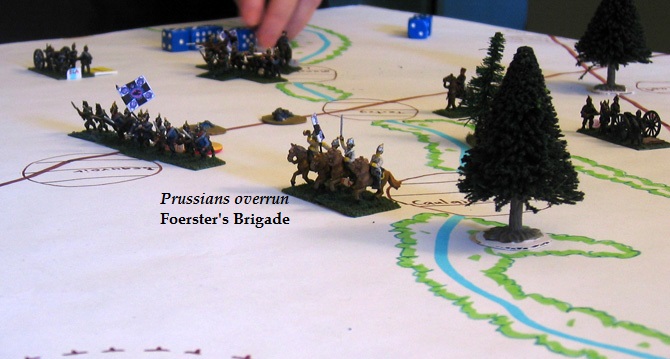
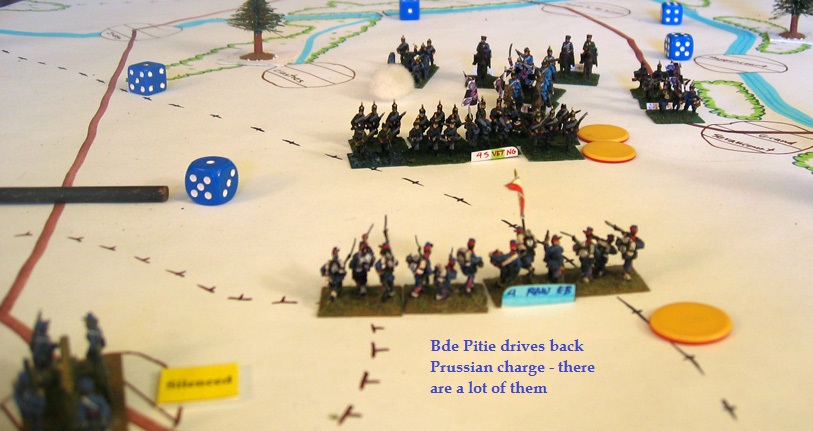
On March 23, 2017 the Corlears Hook Fencibles finished the Franco-Prussian War campaign that we had begun on January 28, 2016. We played 14 battles using the Bloody Big Battles rules, with 15mm figures, mostly Old Glory with some Minifigs and some Lancashire. There was no map movement which greatly reduced the paperwork. That pleased me since I’m the paperwork guy and have done that for other campaigns in years past.

I always led the French and Bill his Prussians. I supplied the Bavarians. I was surprised to discover how many of the battles they appeared in, and were most of the troops on hand for Coulmiers. If you are planning on doing this period, after filling out the Prussian ranks, get Bavarians. Other Fencibles played whatever side they preferred or as dice determined, game by game.

We discovered BBB about two years ago and found the rules hit our sweet spot of simple enough that we don’t get headaches from calculating combat results and yet the game feels right and gives us the period flavor we want. The rules are simple; the elegance sneaks up on you. These are grand-tactical rules, with the smallest unit usually brigades or divisions. The rules first got our attention but over the two years I’ve really begun to appreciate the scenarios designed by the author Chris Pringle. Some of the battles are in the rule book but others have been added to the files of the Yahoo group. We ended up playing 14 games. You may ask why I chose the French when they were thoroughly trashed? They had the best uniforms and I figured doing better than they did – a low bar – would be enough. I managed that. The Germans won 7 games, the French won 3 and 4 games were ties. These victories were according to the scenario, so most French victories would not change the strategic situation. For example, I won the battle of Gravelotte but Bazaine’s army was still cooped up in Metz. The Bavarians won the battle of Coulmiers but they still would abandon Orleans after suffering such heavy losses against superior numbers of the enemy.

We started with the battle of Spicheren, a tie.
No doubt the French pulled out at nightfall as the Prussians kept pouring onto the field. Next we played Froeschwiller and got another tie. This was a hoot, a last stand against spike-helmeted swarms. Beau Geste, anyone? The Prussians did not get the best use of their superior artillery.
Next up we played Borney, a rearguard action near Metz. I got caught up in giving the Prussians a bloody nose and did not start pulling out soon enough, giving the Prussians the win. I also had the idea of giving the Germans enough of a hit to slow them down in future games. I have no idea if that worked.
The win gave the Germans a free re-roll in the next game. For most of the campaign players forgot to use this. In one game it was invoked and the re-roll was just as bad as the original.

Next up was Mars-la-Tour, a wild game that saw a hard-won Prussian victory. That’s another one that might be revisited.
Then at Gravelotte the Prussians were shot down in heaps by Chassepot fire. The Prussians again failed to fully exploit their artillery superiority. I’d like to play this from the Prussian side sometime. The French had their first win.
Next we played Beaumont, where MacMahon’s army fought too much and ran too little, yielding another Prussian victory. It was another interesting scenario.
After some delays as real life interfered with players schedules, we played Sedan. I’d been dreading playing a scenario that starts with the French encircled, but the scenario is actually quite good. A French victory means perhaps some troops escape the trap, but only some. I thought I had a tie but on the last turn the Bavarians stormed into Sedan for a Prussian win. Goodbye Napoleon III, bring on the Third Republic.
We were onto the part of the campaign I really wanted to play, the one many gamers barely know existed.

Next up was the battle of Coulmiers, the only actual French victory of the battles we played. I became fixated on neutralizing the damned Krupp guns. I largely did this but neglected flanking the Bavarian position and ended up making a bloody frontal attack on the town of Coulmiers. Bill had pulled his line back, giving up some objectives to hold the remainder more securely. This combined with my head butting produced a German victory.
The next battle in chronological terms was Beaune la Rolande. Due to an error on my part, we played it after the next two. I can at least put it the correct sequence here. Long story short: mobs of poorly trained French surged up against entrenched Germans and were shot down in droves. A Prussian division that showed up on our left center had a field day cutting swathes through our disorganized troops. A German win, most definitely.
The battle of Loigny was the first battle on snow, as all the rest were to be. I had painted up French naval infantry for this phase on white bases. Loigny saw an extremely bloody tie.
The next battle, Beaugency, saw Chanzy’s French manage to hold their entrenched front line while their left flank was knocked around but not quite broken. This gave us another victory. We would of course fall back at nightfall.
Chanzy’s French army did it again at Le Mans, holding on defensively for longer than the actual force did. Again, we’d hightail it after that.
Then came the Lisaine, where Boubaki’s frozen, sick, hungry mobs assailed entrenched Germans. As in the actual battle, the French were shot down in heaps. On the second day we managed to get across the river in a place where the German defenses were thin, but not near any objectives. And most of our infantry was spent. Rather than complete the game the next week, I conceded – the only time this campaign.
Our last game saw Faidherbe’s Army of the North try to raise the siege of Paris before all the animals in the zoo were eaten. We failed but managed to hold on for a tie.
And that was the end of our year-long campaign. I think we all had a lot of fun. The games certainly produced a lot of jokes. It was enlightening playing all those games in the Republican phase, when the odds were so long but those ragged armies kept up the struggle in the snow.

Friday, March 24, 2017

St. Quentin, January 18-19, 1871

Yesterday evening the Corlears Hook Fencibles played the final game of our Franco-Prussian War campaign using the Bloody Big Battle rules. I conceded the previous Battle of the Lisaine after a good look at the situation, so the Prussians came into this game with a free re-roll of any movement, firing or assault dice. As usual, it wasn’t used. Bill commanded his Prussians aided by Rick and Jay. I led my tattered French seconded by Ken.

All internet images removed from this post, sorry.

We could get a tie by holding St. Quentin and Gricourt. If we could also have a supply train poised on the road to Paris we could gain a victory, though just in game terms. Paris would still submit a week later. This French offensive was made on the orders of the desperate government in Paris. It had very little chance of raising the siege of that city.

I led the 22 Corps with the aim of holding open the Paris road and maybe even exiting troops and trains southward towards Paris, giving Moltke some rough moments before the lights go out. Ken had the 23 Corps which was tasked with holding the two towns.
I traded some fire with the Prussians on the west edge of the table. I should have started withdrawing right away because Prussian reinforcements from the north soon had me in a bind.


The French infantry north of the river was driven back, though the 22 Corps artillery north of the river was silencing enemy artillery, rolling high without going low on ammo (the .22 shells are low ammo markers).

We played a night turn. The sun came up and revealed numerous Prussians who had arrived overnight.

North of the river, a shot-up brigade of raw troops decided their war was over and they hit the road.

South of the canal/river, my line was giving way. It didn’t look like I’d be able to keep 22 Corps supply train in the current location.
A successful assault would see each Prussian unit lose a base since they could not exit the table, and one hit would remove the cavalry unit.
But the brigadier must have tripped over his scabbard as he ordered the attack (how low can he roll?). It failed and the counterattack was deadly.

Things went pear-shaped north of the river too.


We’d been playing slowly. The Prussians thought they could not prevent a tie. We decided to start the last turn of the game. A series of decent movement rolls saw the French infantry garrison St. Quentin and Gricourt, supported by the remaining artillery. The Prussians decided they couldn't take one in a turn and gave us the tie. And so the campaign ended, with 6 German wins, 3 French wins and 4 ties. We started in January 2016. Our campaign was longer than the actual war but then the actual combatants didn’t only fight on Thursdays.

We played slowly, with a lot of joking. It took about 5 hours to play 9 turns and one night interval. The French lost 12 infantry stands (8 more ran away) of 34, 1 artillery and 3 wagon stands (the other 3 ran away). The Prussians lost 2 infantry stands (of 30) and 3 cavalry (2 more ran away) . The French Army of the North was wrecked, even though they held two objectives at nightfall. It would certainly be time to decamp before the sun came up again.

All agreed that this was a good scenario. It’s proof that you don’t need a table crammed with figures to have a good time. Some days from now I’ll post a final summary of the campaign. Any of the participants are welcome to add their take on the campaign as a whole or the individual battles.

In 1914 we’ll get Alsace and Lorraine back. Just wait.

Friday, March 10, 2017

Battle of the Lisaine, January 15-17 1871

As part of our nearly concluded Franco-Prussian War campaign, Thursday evening the Corlears Hook Fencibles started a Bloody Big Battles game of the 1871 battle of the Lisaine. This was a hare-brained attempt to raise the siege of Belfort, on the hope that this would convince Moltke to raise the siege of Paris. In the following report, all Prussian units are in italics.

All internet images removed from this post, sorry.

Bill and Rick played the evil Germans, while Jay and I played the heroic French. We outnumbered the enemy by more than 2-1 in infantry, though our troops were exhausted, frozen, starving and poorly trained. The enemy was largely entrenched, in one case in a town converted to a fort. We had a free re-roll available since our previous game saw a French win. The last time the French sent a raw army against entrenched Germans the result was a whipping with a heavy butcher’s bill. We were determined to break into the enemy line.

On the first turn Rick’s Landwehr knocked out my weak mitrailleuse battalion. No machine guns for us.


We struggled with command problems and dense terrain, all the while under enemy artillery fire. I launched an attack on the enemy fort. Do you recall the last battle scene from Glory?

The pinned-down troops were swept away by fire from front and both flanks. Jay launched an attack on his front.

More attacks went in.

Here I made a mistake, calling the first night turn after the 4th turn instead of the 5th turn. A French division had got into the gap, forcing the Landwehr to fall back. But at night, the shot up French unit panicked and fled.
The French left.


A French division got back into the gap and was disrupted by enemy fire. The enemy fell back.

Another French division got across the Lisaine and moved to expand the gap to the left.
But the hour was growing late and we were starting to get punchy. Not counting the dinner break, we had played for about 5 hours, completing 7 turns and a night turn. The consensus was that the French had a hard row to hoe to get a tie, victory being out of sight. The place where we got across the easily fordable Lisaine River wasn’t near any objectives. And the losses had been stupendous. French losses were 26 stands of infantry (3 ran away) of 97, and our sole machine gun unit knocked out before it could fire a shot. Prussian losses so far were 3 infantry stands. We had hit another on the first day but it regrouped at night. This is by far the most one-sided losses we’ve seen in two years of playing Bloody Big Battles.

I did have the pleasure of seeing a brief moment of confusion in the enemy camp. Rick had been calling for reinforcements as the French slowly got into the gap in his line. Bill sent the Baden cavalry. Later he sent some artillery to back Rick up. Rick spotted the artillery and had a bad moment when he thought they were French. I couldn’t convince him to fire on them.


We have three turns left of the second day. Should the French actually take an objective, the Germans have the option to call another night turn and one daylight turn after to try to recapture the place. Of the 13 infantry divisions in our field force, 9 are spent, one is completely gone, and three are still capable of offensive action. Two of those are across the river though not in a critical area. I have to decide if we will continue to play this long shot for a tie next time we meet, or just throw in the towel and grant a German victory. I usually don’t concede, but wonder about this one. In any case, it will be a couple weeks before our next session.