Camden S.C. August 16, 1780 each base = 100 infantry, 50 cavalry or 4 guns
The fall of Charleston left South
Carolina at the will of the British army, save for guerilla activity by Francis
Marion and Thomas Sumter. The victor of Saratoga, Horatio Gates, was sent to
redress this. He chose a path through country devoid of supplies against the
advice of his generals. Both armies tried to steal a march in the night. After
a confused nighttime encounter that nearly saw panic in Gates’ army, both sides
deployed in the dark. Gates discovered that
his army was about 3,000 strong instead of the 7,000 he assumed it was.
Continental
Army Horatio Gates, 3,350
DeKalb
Division Firebrand
4
Tr Smallwood
1st Md Brigade
6 Tr Gist
2nd Md Brigade + Delaware
1
SA 6
lb. guns
Caswell
NC Militia Brigade
4
F Raw 1st
NC
4
F Raw 2nd
NC
4
F Raw 3rd
NC
Stevens
VA Militia Brigade
4
F Raw 1st
VA
3
F Raw 2nd
VA
1
LA 3
lb. guns
Independent
units
4
F Tr Porterfield
State troops, not Continentals
2
F Tr Armand’s
Legion cavalry
1
Camp or wagon model on baseline behind center.
33
infantry bases, 2 artillery, 2 cavalry , 1
leader
All
Raw infantry is Fragile and Poorly Drilled
DeKalb is a
Firebrand and adds +1 in Assault to an attached unit
British
Army Cornwallis, 2,132
Rawdon
Brigade Firebrand
4 Tr Hamilton
NC Regt. & Legion Foot
3 Tr Irish
Vols Loyalist
3
F Raw Bryan’s
NC Vols
1 LA 3
lb. guns
Webster
Brigade
3
A Vet 33rd
Foot
4
A Vet 23rd
Foot & Lt Infantry
1 SA 6
lb. guns
Reserve
directly under Cornwallis
3
A Vet 71st
Foot Highlanders
4
A Tr Legion
Dragoons
1
Camp or wagon model on baseline behind center.
20
infantry bases, 2 artillery, 4 cavalry, 3 leaders
The
Raw NC Vols are Fragile and Poorly Drilled
Game
lasts 7 turns. British deploy second, move first.
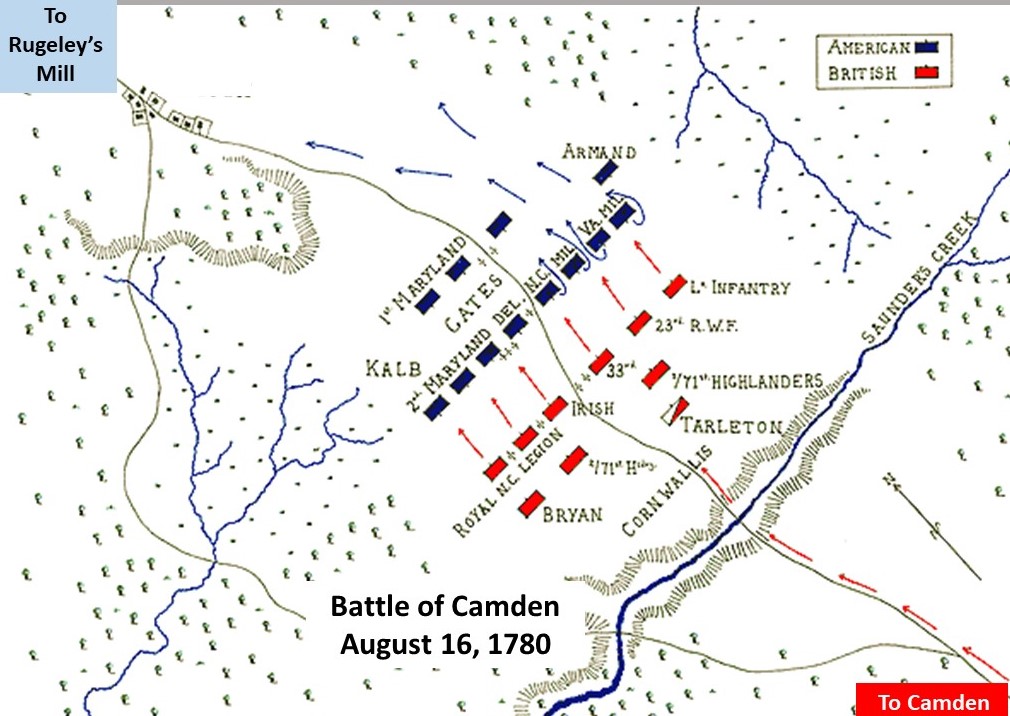
Historical
deployment map:
https://allthingsliberty.com/wp-content/uploads/2023/10/BattleMap.jpg
Note
how large and small units have similar footprints, a suspicious feature on many
maps of this battle. The Historical deployment is heavily balanced against
Gates.
Scenario rules: All Raw Continental
units start out with a disrupted marker, upset by the misguided order to attack
the British. If two Rebel units rout, Gates flees and all Raw units also become
passive. Units that exploit may loot the enemy camp. A unit must roll a
full move to stop looting.
Victory: both sides are trying to break the
enemy army. Each army breaks when 5 units and/or leaders have been destroyed or
routed off the table. Each leader, Trained Continental base (not State troops) or camp looted lost counts
as 2, other bases count as 1 each. If your score is twice the enemy score or
more it is a decisive victory. If at least 50% more it is a substantial
victory. Otherwise, a higher score earns a marginal victory.
Summary: Gates’ left and center contained his
least dependable units, facing the best British units. The Virginia and
North Carolina militia, ordered to attack the British, instead became
disordered. Panicking at the British advance, many threw down their weapons
without firing a shot. They fled the field, taking Gates with them. He
abandoned the army, riding 180 miles in three days. He must have had a fine
horse. De Kalb was giving Rawdon’s brigade a very hard time, until flanked by the
British right wing and reserve. De Kalb was mortally wounded, shot and
bayoneted many times, fighting like a lion until the end. It was one of the
worst American defeats of the war. Both Gates and De Kalb have streets and
subway stations named for them in Brooklyn, Gates surely for Saratoga rather
than this debacle.
What if: Gates deploys in a sensible fashion.
The British sketch a map of their deployment. Then the Americans deploy within
16” of their table edge, followed by the British within 16” of their table edge
according to the sketch. American militia starts without disrupted markers.
Surely you can do better.
I have merged various infantry units to avoid a profusion of tiny units.

No comments:
Post a Comment